• Skip to main content
  • Skip to primary sidebar
  • Skip to footer

Looseleaf Editorial & Production

Book Editing & Design

  • Editing
    • Big-Picture Editing
    • Line Editing
    • Copyediting & Proofreading
  • Book Design
    • Book Layout
    • Ebook Formatting
    • Other Graphic Design
  • About
    • The Team
    • Our Work
    • Find Your Fit
    • Testimonials
  • Resources
    • Resources
    • Events
  • Blog
  • Contact

young adult

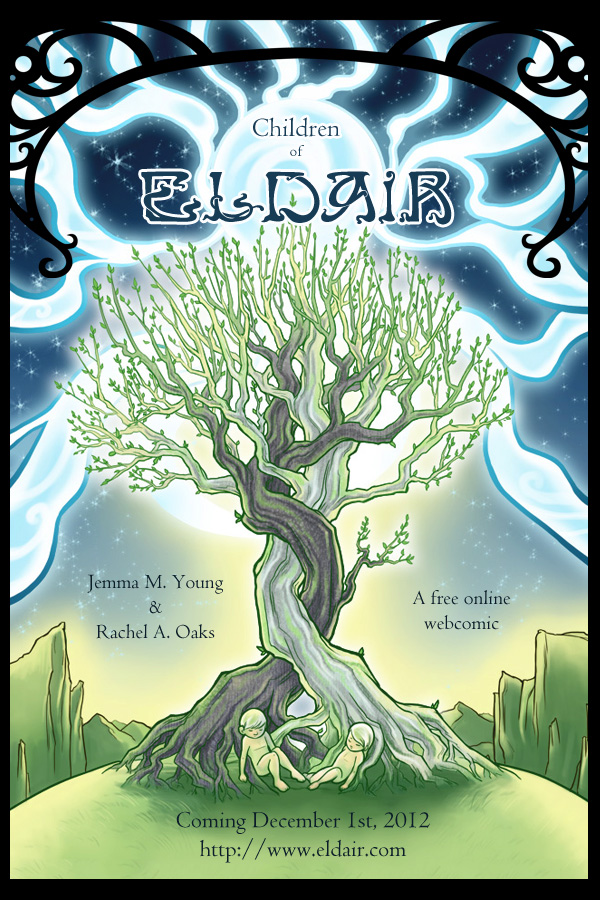
New Webcomic: Children of Eldair by Rachel Oaks & Jemma Young

December 1, 2012 by Kristy S. Gilbert Leave a Comment

Koe LeKai was content to live his centuries-long life isolated in his cavernous home, but a strange sign in his stargazing lures him away from his solitude. Upon encountering a horde of monstrous flesh eaters, he eradicates them and saves a young woman, Embera, from being torn into scraps. While Embera is grateful for his help, she harbors a secret that Koe will only come to understand through time, magic, and the ever-guiding wisdom of the stars.
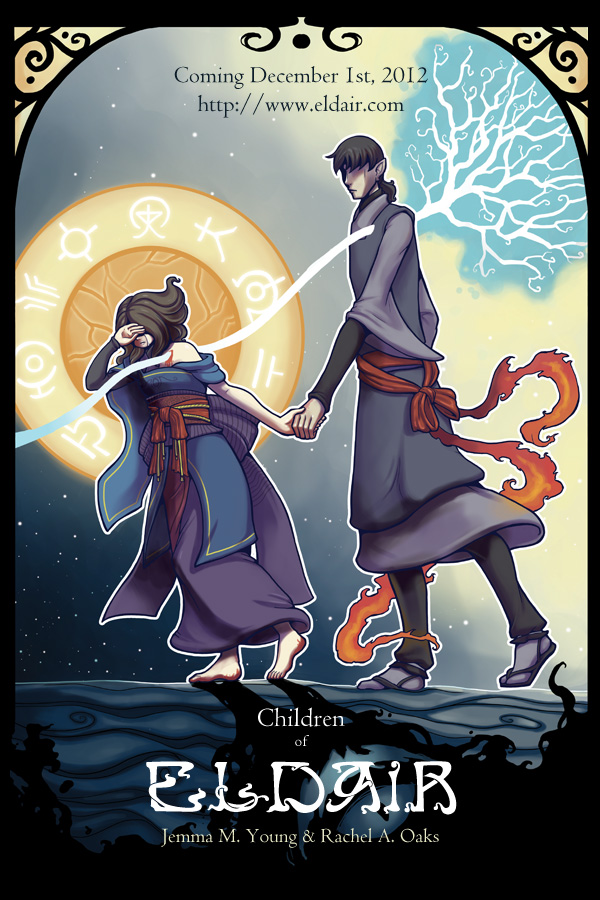
It’s time to announce a new webcomic from Rachel Oaks and Jemma Young. These two talented women are close friends of mine, and I’ve had the privilege of seeing this storyline (and the art that goes with it) go through various incarnations.

The comic goes live today, December 1, and I know for a fact that they have quite a buffer built up, so you’ll get regular updates of fantasy-comic goodness even if you start reading right now. To get started, just visit Eldair.com. The comic will update every weekday for the first chapter. After that updates will come every Monday and Thursday.

If you need more convincing, watch this video below. Rachel will compliment you into submission.
Filed Under: Publishing, Randomity Tagged With: book release, Children of Eldair, illustration, Jemma Young, Rachel Oaks, webcomic, YA, young adult

Leaflet Review: Miss Peregrine’s Home for Peculiar Children by Ransom Riggs

October 1, 2012 by Kristy S. Gilbert Leave a Comment

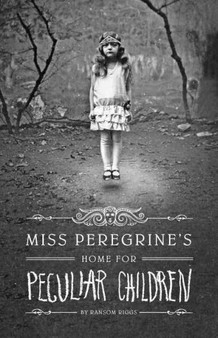
Cover of Miss Peregrine's Home for Peculiar Children by Ransom RiggsA mysterious island. An abandoned orphanage. A strange collection of very peculiar photographs.

It all waits to be discovered in Miss Peregrine’s Home for Peculiar Children, an unforgettable novel that mixes fiction and photography in a thrilling reading experience. As our story opens, a horrific family tragedy sets sixteen-year-old Jacob journeying to a remote island off the coast of Wales, where he discovers the crumbling ruins of Miss Peregrine’s Home for Peculiar Children. As Jacob explores its abandoned bedrooms and hallways, it becomes clear that Miss Peregrine’s children were more than just peculiar. They may have been dangerous. They may have been quarantined on a deserted island for good reason. And somehow—impossible though it seems—they may still be alive.

Normally I’m not very good at enjoying a book that I think is a standalone, but is actually an introduction to something more. Normally I get a bit perturbed by books that spend a long time setting things up and keep me from fully understanding the worldbuilding for a long time. Normally I wouldn’t have been able to finish a book like Miss Peregrine’s Home for Peculiar Children.

But this book does things differently. The slow discovery of the world of the peculiar children is natural, and the steady pace at which the reader’s understanding unfolds somehow sits just right. It helps that the main character, Jacob, is as ignorant as the reader—anything he knows, you know, but anything he doesn’t, you don’t.

I’ll admit, the fact that it isn’t a standalone when that was my expectation was jarring.  I’m not particularly fond of being jarred. However, I found the children in the book—their personalities, their powers, their different reactions to their predicament—so interesting that even when I realized there was no way the story could wrap up by the end of the book, I didn’t get too upset. I appreciate that a good number of the children are treated as individuals instead of as a lump-sum group. An experience that makes one child an academician of everyday events turns another into a borderline sociopath who, frankly, makes me nervous (it doesn’t help that he keeps various body parts preserved in jars in the basement).

In short, the character development of the book makes my usual deal-breakers fade into the background. I enjoyed Jacob’s development from a loser teen to a bereaved grandson to the person he becomes by the end of the book. I enjoyed meeting the peculiar children right along with him and seeing his relationships with them develop. And it certainly didn’t hurt that there were pictures in the book (there are far too few pictures in “grown-up” books). If you’re looking for something with some strong characters and just a bit of creepiness, this book is a good place to look.

Content warnings: None that I can remember.

Filed Under: Reviews Tagged With: book review, fantasy, Miss Peregrine's Home for Peculiar Children, Quirk Books, Ransom Riggs, YA, young adult

Leaflet Review: Railsea by China Miéville

September 28, 2012 by Kristy S. Gilbert Leave a Comment

I apologize for the hiatus—I know it’s been a while. The good news is that I’ve haven’t been posting because a series of exciting adventures have struck: the whole pregnancy thing (only five weeks until the little guy comes!), moving back to Utah from Texas, and starting graduate school are just a few of them. Because of all the adventures, after the next three book reviews (this one included), I’m only going to post once a week, on Wednesdays, instead of the Monday-Wednesday-Friday schedule I used to have. Now, speaking of adventures, here’s a look at China Miéville’s latest work: Railsea.
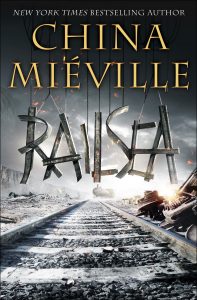
Cover for Railsea by China Miéville

On board the moiletrain Medes, Sham Yes ap Soorap watches in awe as he witnesses his first moldywarpe hunt: the giant mole bursting from the earth, the harpoonists targeting their prey, the battle resulting in one’s death & the other’s glory. But no matter how spectacular it is, Sham can’t shake the sense that there is more to life than traveling the endless rails of the railsea—even if his captain can think only of the hunt for the ivory-colored mole she’s been chasing since it took her arm all those years ago. When they come across a wrecked train, at first it’s a welcome distraction. But what Sham finds in the derelict—a kind of treasure map indicating a mythical place untouched by iron rails—leads to considerably more than he’d bargained for. Soon he’s hunted on all sides, by pirates, trainsfolk, monsters & salvage-scrabblers. & it might not be just Sham’s life that’s about to change. It could be the whole of the railsea.

A Unique Spin on Classic Stories

As you may have guessed from the book description, Railsea bears traces of Moby Dick in it, only instead of hunting a great white whale, the crew of the Medes is hunting an ivory mole (the captain is certain to inform anyone who thinks otherwise that Mocker Jack is not yellow). But as I read, I found that the actual plot line bears a stronger resemblance to Treasure Island. Young Sham longs for adventure and finds a bit too much of it along his way.

However, as one would expect of Miéville, although the book draws on these classic stories, it has a texture and a feeling that is all its own. The dingy, polluted atmosphere of the world of the railsea permeates the book and makes it settle into your mind even when the scenes are on the lighter side. The worldbuilding is in depth and shows itself in everything from the way the world’s inhabitants think about dirt and water to the way the words appear on the page (the word “and” is never used, only the ampersand). Railsea’s world is, well, not necessarily a delight, but certainly a unique draw for the book. (I can’t use delight because that implies sunshine and butterflies, but between the polluted cloud of the upsky and the bizarre mutations it causes for airborne creatures, you find little of either on the railsea.)

A Lackluster Main Character

Although the setting was compelling, I found it difficult to read Railsea quickly (quite the change from how I felt about Embassytown). This was largely because the main character, Sham, didn’t particularly interest me. He is a young boy without much direction in life: he longs for some kind of purpose, but since he doesn’t know what he wants, he simply drifts from task to task and from event to event. That attitude doesn’t really change until at least halfway through the book, and by that time I’d failed to connect with him. This stands in stark contrast with Avice from Embassytown, who was a self-proclaimed societal drifter, but who was compelling anyway. However, like Avice, Sham changes a lot over the course of the book, and his growth is realistic. He just isn’t as compelling.

Final Thoughts

Outside of the main character issue, I think the book was particularly strong. I enjoyed the stylistic prose quirks—the self-aware narrator, the asides about storytelling, etc.—even when they interrupted the flow of the narrative. Speculative fiction is prone to info dumps, and many people hate them (myself included) as a general rule. But in Railsea, Miéville selectively info dumps in a few chapters, never taking more than a page or two at a time. The voice is so compelling that the info dumps don’t feel like info dumps, and the timeouts from the main plot were some of my favorite parts of the book.

Content warnings: Some violence, though it isn’t trivialized; some language, though nothing you wouldn’t hear on TV; drinking; sideways conversations about sex, but no sexual scenes.

Filed Under: Reviews Tagged With: book review, character, China Miéville, Del Rey, fantasy, Railsea, science fiction, YA, young adult

Leaflet Review: A Hat Full of Sky by Terry Pratchett

September 28, 2011 by Kristy S. Gilbert Leave a Comment

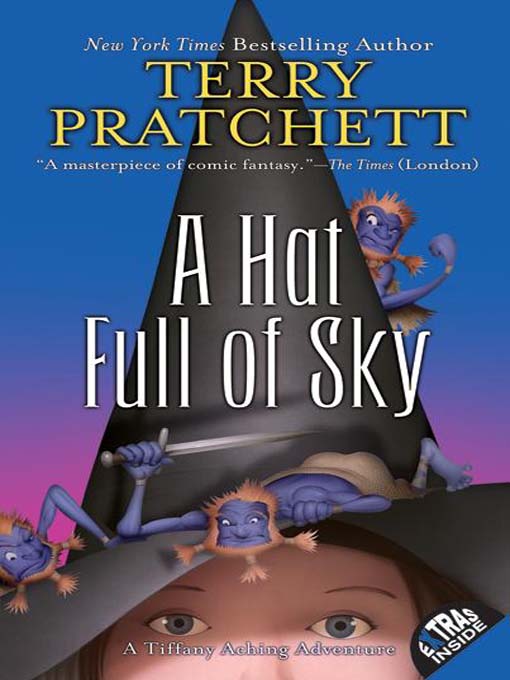
A Hat Full of Sky by Terry PratchettWitch-in-training Tiffany Aching hadn’t expected magic to involve chores and ill-tempered nanny goats! But as Tiffany pursues her calling, a sinister monster pursues Tiffany, and neither mistress Weatherwax (the greatest witch in the world) nor the six-inch-high Wee Free Men (the greatest thieves in the world) can defeat it. When the monster strikes, Tiffany will have to save herself—if she can be saved at all!

I love Terry Pratchett, so I can hardly say anything bad about his books—even though, with so many books on the market, I’m bound to not like some of them. But I liked A Hat Full of Sky. Perhaps not so much as its predecessor, The Wee Free Men, but it was still a very enjoyable book. As always is the case with Pratchett, I both laughed out loud and had a bit of thinking time to go with it.

That said, there were several times where I thought the main conflict had been resolved, only to discover there was a new conflict (though, to be fair, these conflicts were always attached and related; I just don’t think they were foreshadowed). They felt a bit tacked on, if you ask me. However, all the conflicts were thematically consistent, even if they didn’t seem to be all part of the same action arc, so it wasn’t really bad. I was just expecting a book unified by a single action; if I’d been expecting a thematic work I wouldn’t have noticed it at all.

As with The Wee Free Men, the book waxes philosophical. (What? In a children’s book? Absurd.) Pratchett gets away with it because it’s natural to the character—all the ideas are in Tiffany’s voice and they’re things Tiffany would think, what with her First, Second, and Third Thoughts running around. She’s bound to run into some heavy thinking. The other reason it works so well is that Pratchett makes you laugh while he’s going about it, and the things he talks about aren’t controversial in any way: they’re just thing you may not have thought about very much before. Like how full the universe is of things that are interesting an amazing, and how you should never reduce people to things, etc. He couches them in a context that brings the ideas home.

(As a side note, The Wee Free Men introduced ideas that I repackaged and repurposed for discussion in a literary theory class in college. My comments were referenced throughout the semester for their brilliant-ness and relevance, and I felt a little dirty not mentioning that I’d gotten them from a humorous young-adult fantasy novel. But you can’t parenthetically cite your source while you’re talking. At least, I haven’t figured out how to yet.)

That’s really what Pratchett does for me: He takes things I should know and presents them in a mirror that’s ever so slightly askew so I’ll actually see them. Defamiliarization is the term, I believe. And while he defamiliarizes he delights, so I can never complain about a Pratchett book. I’ll definitely be reading the next book in the Tiffany Aching plot arc (once I chew through the stack of books next to my desk, that is), and I’ll probably end up buying them all so future children who use my house as a library will be able to read them. I wish I’d read them as a kid.

Filed Under: Publishing, Reviews Tagged With: A Hat Full of Sky, book review, fantasy, fiction, middle grade, Terry Pratchett, young adult

Weekly Roundup: 9/3–9/9

September 9, 2011 by Kristy S. Gilbert Leave a Comment

Cory Doctorow: “Why Should Anyone Care?”

Cory Doctorow shares his thoughts about working at a bookstore and how that opened his eyes to how the book-producing industry chugs through the years. He also provides some practical thoughts on self-publishing based on his own experience. My favorite quote: “I knew I’d have to do some of the stuff my publisher had done, but like everyone doing something complicated for the first time, I dramatically underestimated how much work this would be. ”

Stacy Whitman: “Some Thoughts on Middle Grade Voice”

The editorial director of Tu Books shares her thoughts on voice in general and the middle grade voice in particular (I thought this article would follow up last week’s Wordplay podcast quite well). She focuses on how hard humor is, and why it’s really bad if your writing displays the difficulty of your undertaking.

Nathan Bransford: “Publishers Are Squandering Their Cachet On Imprints”

Nathan Bransford presents a post about how publishers lend credibility to authors associated with their brand name—and why that credibility may be squandered on lesser-known imprints and specialty groups. (I’d like to comment more on this, but I recognize more imprints than most people should, so I can’t really say which imprints are actually adding brand-name power to a book.)

Wordplay Podcast Episode 2: “Character, Plot, & Protagonists”

This week the Wordplay team has Ally Condie, the author of Matched, as a guest on episode 2.They talk about the difference between character-driven and plot-driven fiction, and why you need a balance between the two. They also harangue the idea of a paper cutout villain who doesn’t have believable motives or a certain degree of emotional complexity.

Writing Excuses 6.14: “Suspension of Disbelief”

The Writing Excuses crew has Patrick Rothfuss joining them for a podcast about suspending your reader’s disbelief. Some highlights: don’t make everything too tidy, don’t betray human nature, lay your groundwork, and make use of the slow build to absurdity. Rothfuss also highlights the concept of bathos, which boils down to undercutting serious or weighty things with commonplace events or thoughts.

Jon Schindehette: “Is Illustration a Viable and Productive Art Form?”

Illustration is the art of books, from two-page illustrated spreads to covers. In this post Jon Schindehette (creative director at Wizards of the Coast) briefly looks at illustration as an art form from an artist’s standpoint. He also addresses the viewpoint of an art director or editor. “[Art directors and editors] are responsible for ensure [sic] the artist that is chosen is appropriate for the task at hand, but they are also responsible for communicating the ‘needs of the text’ so that you [the illustrator] understand what success will look like.” If you’re an author looking into being your own publisher, you should also start thinking about what it takes to be your own art director as well.

Kristin Nelson: “In The Author’s Shoes”

Agent Kristin Nelson shares a conversation she had with an author who has recently changed agents. The author pointed out three things every author should be sure of before signing with an agent. Kristin adds her thoughts on each point. These points serve as a reminder that the author–agent relationship should be a partnership, and you should approach it as such. If you can’t ensure they’ll be a good business partner, you shouldn’t be signing with them.

Filed Under: Publishing Tagged With: Ally Condie, Brandon Sanderson, Cory Doctorow, Dan Wells, epublishing, fiction, Howard Tayler, J. Scott Savage, James Dashner, Mary Robinette Kowal, middle grade, Nathan Bransford, Patrick Rothfuss, weekly roundup, Wordplay, Writing Excuses, young adult

Primary Sidebar

Hire Looseleaf

· Reserve a Fiction Manuscript Evaluation
· Other Editing Services
· Design Services
· Contact Looseleaf

Testimonials

She really made my book shine by offering insightful and helpful feedback and catching more inconsistencies than I could have ever managed on my own.
Madison Custudio, contemporary romantic fantasy author
Kristy’s talents and hard work on the book’s layout and design can be seen on every page.
Brandon Sanderson, NYT bestselling fantasy author
Kristy does a fantastic job every time. She’s punctual, thorough, affordable, and great to work with.
Brian McClellan, fantasy author
Kristy took me through the formatting process with ease and assurance. I quickly trusted her and her opinions and knew that the end result would be a quality product. … She is talented, creative and professional in all aspects of her services.
Cynthia Anderson, nonfiction author
Kristy is a joy and a pleasure to work with. She works quickly and efficiently with steep deadlines, and has an eye for detail that has helped me tremendously. … I highly recommend her.
Charlie N. Holmberg, Wall Street Journal bestselling author
Through several iterations of my manuscript, Kristy has been relentless in showing me where pieces were in the wrong place, were starved for elaboration, or belonged in an entirely different puzzle. … I don’t want to imagine what my project would look like without her.
Ron Felt, literary fiction writer
I have used Looseleaf for a number of projects, and have always been incredibly pleased by their speed, quality, and professionalism. … Phenomenal work, and I’ll definitely continue to use them for every project I can.
Dan Wells, New York Times bestseller

Newsletter signup

Please wait...

Thank you!

Footer

About Us

Looseleaf Editorial & Production was founded in 2011 with one goal: to help authors and publishers get their books ready for readers.

We specialize in top-notch editing and reader-focused design to help your story shine.

Let us help you next!

Contact Us

Our Work

This One’s For You by Kate Sweeney

This One’s For You by Kate Sweeney

Empire & Oracle

Empire & Oracle

Neom by Lavie Tidhar

Neom by Lavie Tidhar

Recent Articles

New Content Disclosures Policy

April 29, 2022 By Kristy S. Gilbert

Meet the Looseleaf team: an image with three headshots in it.

Looseleaf Is Growing!

March 15, 2022 By Kristy S. Gilbert

LTUE 2022 Schedule

January 10, 2022 By Kristy S. Gilbert Leave a Comment

Copyright © 2026 · Looseleaf Editorial & Production · Log in